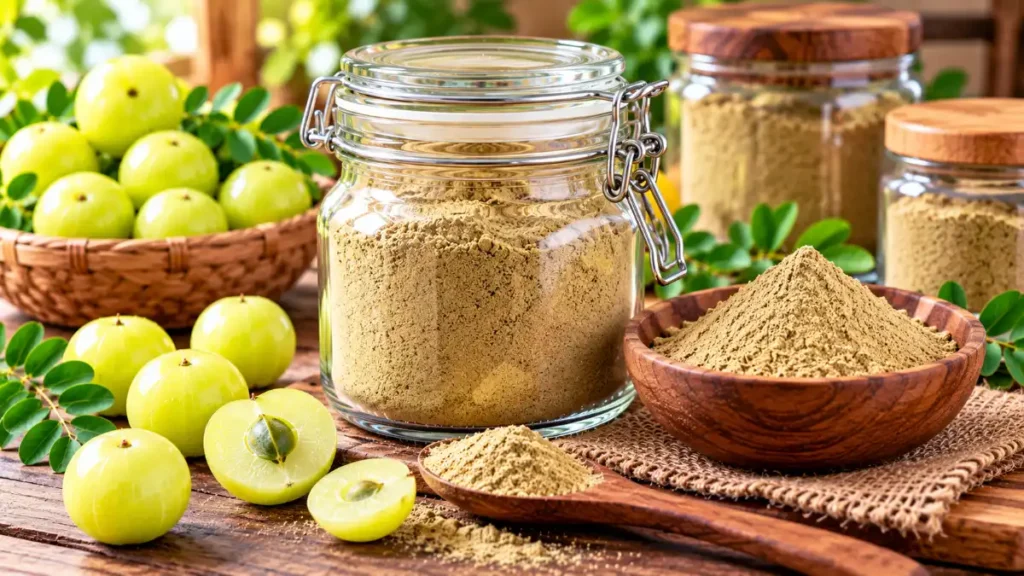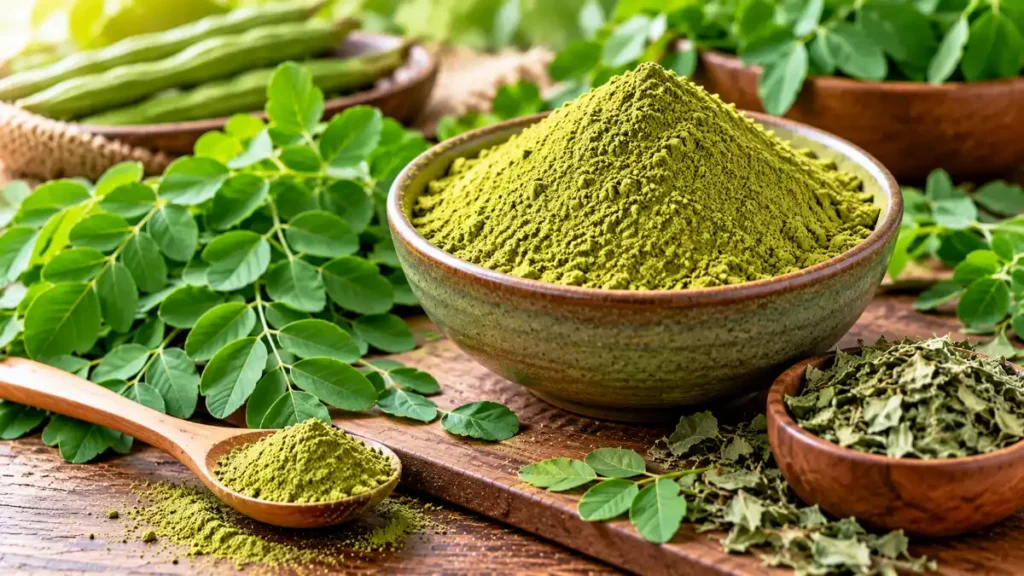
Moringa powder is made by drying and finely grinding the leaves of Moringa oleifera, a tree commonly known as the drumstick tree. In India, fresh moringa leaves are used in everyday cooking, while dried leaf powder has become a convenient way to add moringa to drinks, dals, curries, smoothies and other foods.
What makes moringa powder interesting is not just its popularity as a health product. The leaves contain a range of nutrients and plant compounds, which is why moringa has attracted attention in food and nutrition research. Recent reviews have highlighted its nutritional composition and potential functional-food applications, although research on specific health outcomes is still developing.
In this guide, we will look at what moringa powder is, where it comes from, its nutrition, common uses, potential benefits, safety considerations and practical ways to use it at home.
Table of Contents
What Is Moringa Leaf Powder?
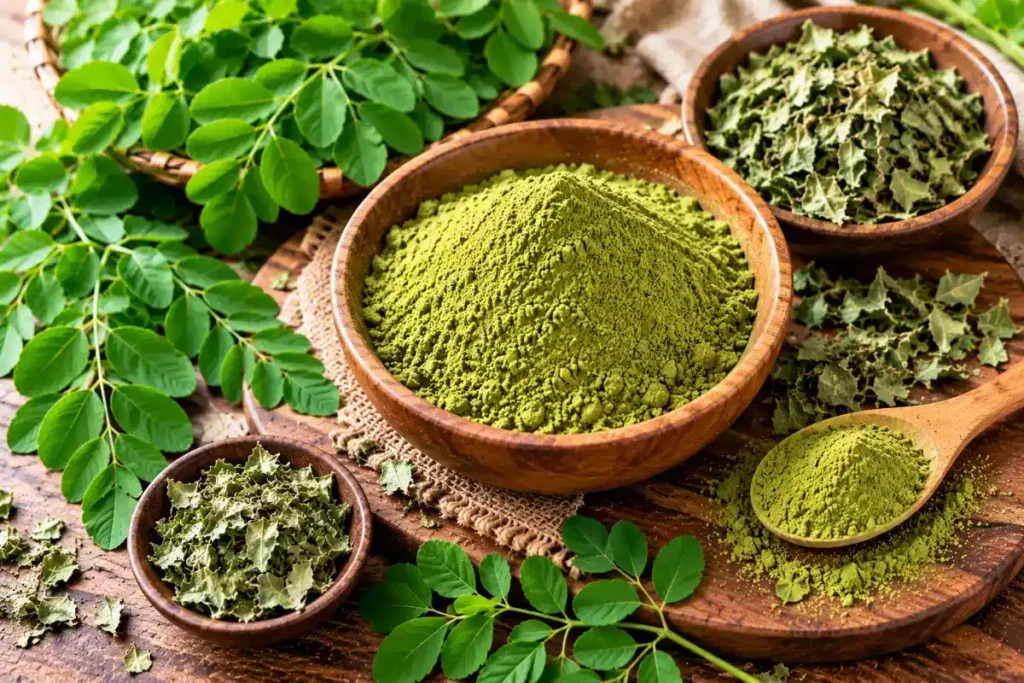
Moringa powder is generally prepared from cleaned, dried moringa leaves that are ground into a fine powder.
The botanical name of the plant is Moringa oleifera. It is also commonly called the drumstick tree because of its long, slender seed pods.
Different parts of the moringa plant are used in food and traditional practices, including the leaves, flowers and immature pods. However, when people talk about moringa powder as a food ingredient, they are commonly referring to dried moringa leaf powder.
The quality of the finished powder depends on several factors, including:
- Freshness of the leaves
- Cleaning and preparation
- Drying conditions
- Moisture control
- Grinding
- Storage
Proper drying is particularly important because moisture can affect the quality and storage stability of dried plant powders.
Where Does Moringa Powder Come From?
Moringa powder comes from the leaves of the moringa tree.
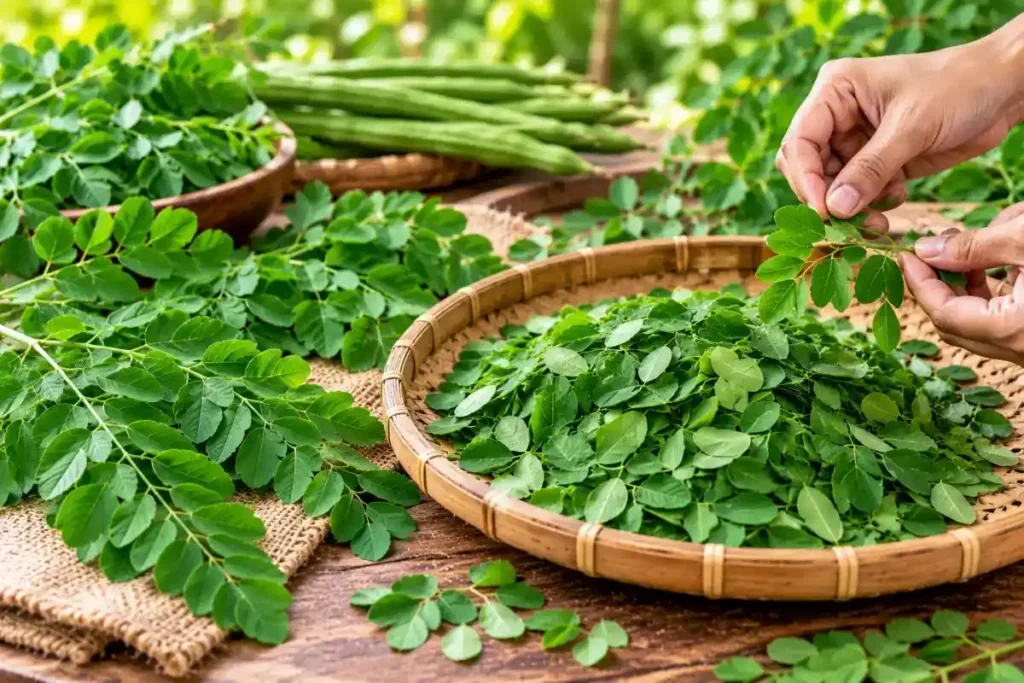
Fresh moringa leaves are first separated from unwanted stems and damaged material. They are then cleaned and dried before being ground into powder.
A simple production process looks like this:
Fresh moringa leaves → Cleaning → Drying → Grinding → Sieving → Storage
The exact method can vary depending on whether the powder is made at home or commercially.
If you want to prepare it yourself, the drying stage deserves particular attention. The leaves need to become sufficiently dry before grinding because residual moisture can make the powder clump and reduce its storage quality.
We will cover the complete homemade process in our detailed guide on how to make moringa powder.
Moringa Leaves vs Moringa Powder
Fresh moringa leaves and moringa powder come from the same plant, but they are used differently.
| Moringa Leaves | Moringa Powder |
|---|---|
| Fresh ingredient | Dried ingredient |
| Used in cooked dishes | Easy to mix into many foods |
| Higher moisture content | Low-moisture food ingredient |
| Needs fresh storage | Easier to store when properly dried |
| Usually cooked before eating | Can be added in small amounts to food or drinks |
One advantage of moringa powder is convenience. Instead of washing and preparing fresh leaves every time, you can keep a properly dried powder available for regular cooking.
However, powder is not automatically better than fresh leaves. They are simply two different forms of the same ingredient.
What Is it Used For?
Moringa powder can be used as a food ingredient in many everyday preparations.
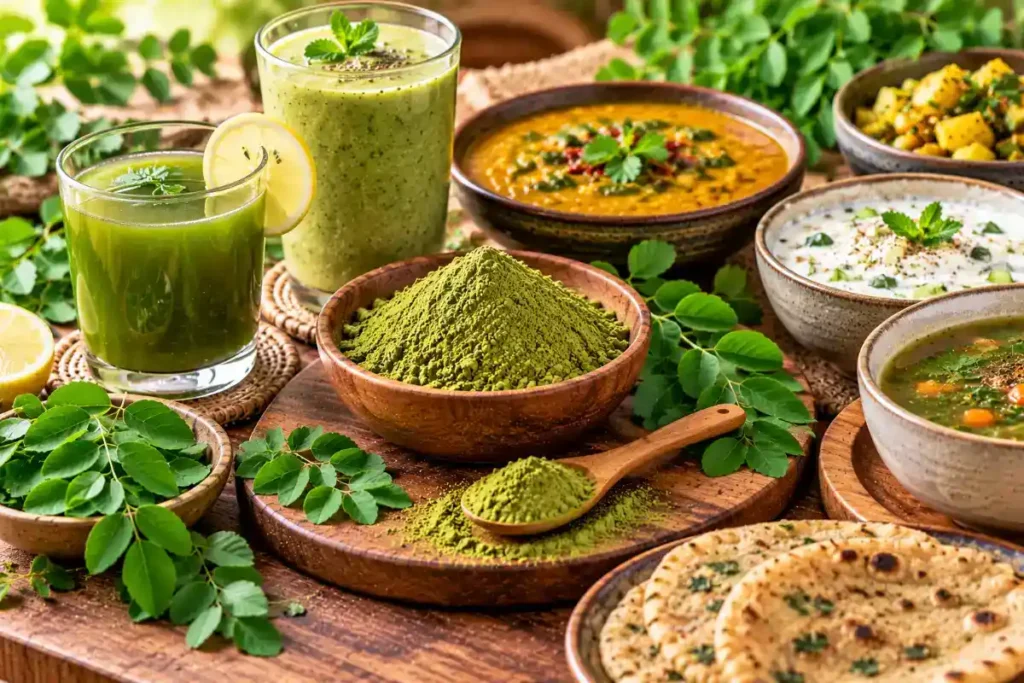
Some common uses include:
- Mixing into water
- Adding to smoothies
- Stirring into curd or chaas
- Adding to dal
- Mixing into soups
- Adding to chutneys
- Mixing into roti or paratha dough
- Adding to savory breakfast dishes
- Preparing moringa tea-style drinks
- Seasoning selected homemade recipes
The amount used can depend on the recipe and personal taste. Moringa has a distinctive green, earthy and slightly bitter flavour, so adding a large amount at once may make food less pleasant.
For everyday cooking, it is usually better to start with a small amount and adjust according to taste.
Moringa Nutrition
Moringa leaves contain a variety of nutrients and bioactive plant compounds. Scientific reviews have described moringa leaves as sources of vitamins, minerals, protein, fibre and phytochemicals, although the exact nutritional composition can vary according to growing conditions, processing and preparation.
A recent comprehensive review of Moringa oleifera leaves discusses their nutritional composition, phytochemicals and potential functional-food applications. [Read the PubMed review on Moringa oleifera leaves]
PubMed — Moringa oleifera Leaves Review
Moringa leaves also contain compounds such as flavonoids and other phenolic substances that have been investigated for their antioxidant activity.
This is one reason moringa powder nutrition is frequently discussed alongside its use as a functional food ingredient.
However, it is important not to treat a spoonful of moringa powder as a replacement for a varied diet. The nutritional contribution depends on how much is actually consumed and on the composition of the particular powder.
Potential Benefits of Moringa
The phrase moringa powder benefits is widely searched online, but it is important to separate nutritional properties from proven medical effects.
Research has identified several interesting compounds in moringa leaves, and laboratory and animal studies have investigated antioxidant, anti-inflammatory and metabolic effects. Human research exists as well, but the evidence is not strong enough to treat moringa powder as a proven treatment for diseases.
Nutritional Benefits
Moringa leaves can contribute nutrients and plant compounds to the diet.
When used as a food ingredient, the powder can therefore be one small way of adding leafy-plant nutrients to meals.
Antioxidant Compounds
Moringa leaves contain various phytochemicals, including phenolic compounds and flavonoids that have been studied for antioxidant activity.
This does not mean that drinking moringa powder automatically prevents disease. Rather, it means that the plant contains compounds that are scientifically interesting and continue to be studied.
What About Blood Sugar?
Moringa has been investigated for its possible effects on glucose metabolism.
Some laboratory, animal and human research has produced promising findings, but the evidence is still inconsistent. A recent review noted that animal studies have produced encouraging results while human evidence remains less conclusive.
A 2025 review also notes that findings from human trials are less conclusive and that more clinical research is needed. [See the PubMed review on Moringa and diabetes research]
PubMed — Moringa and Diabetes Research Review
Therefore, moringa powder should not be used as a substitute for diabetes medication or medical treatment.
What About Blood Pressure and Heart Health?
Moringa is also being studied for possible cardiovascular and metabolic effects.
At present, however, there is not enough high-quality evidence to recommend moringa powder as a treatment for high blood pressure, high cholesterol or heart disease.
It is more appropriate to think of moringa as a nutrient-containing food ingredient rather than a medicine.
How to Use Moringa
There are many simple ways to use moringa powder at home.
Moringa Powder With Water
One of the simplest methods is mixing a small amount with water.
Start with a small quantity because the flavour can be quite strong. Stir thoroughly and drink it soon after mixing.
If the taste is too bitter or earthy, using moringa in food may be more enjoyable.
Moringa Powder in Smoothies
Moringa powder can also be added to a fruit or vegetable smoothie.
It works particularly well with ingredients that have naturally strong flavours, such as:
- Banana
- Mango
- Pineapple
- Apple
- Ginger
- Yogurt
The goal is not to use a large quantity. A small amount can be easier to incorporate without overpowering the drink.
Add It to Dal
Dal is one of the more practical ways to use moringa powder.
You can add a small amount after cooking and mix it thoroughly. The strong flavour of dal, spices and other ingredients can make the powder less noticeable.
Add It to Soups
Moringa powder can also be stirred into soups.
For best texture, mix the powder with a small amount of liquid first and then add it to the soup rather than dropping a large dry amount directly into the pot.
Mix It With Curd or Chaas
A small amount of moringa powder can be mixed with plain curd or chaas.
This can be a convenient option when you do not particularly enjoy drinking moringa with plain water.
How Is It Made?
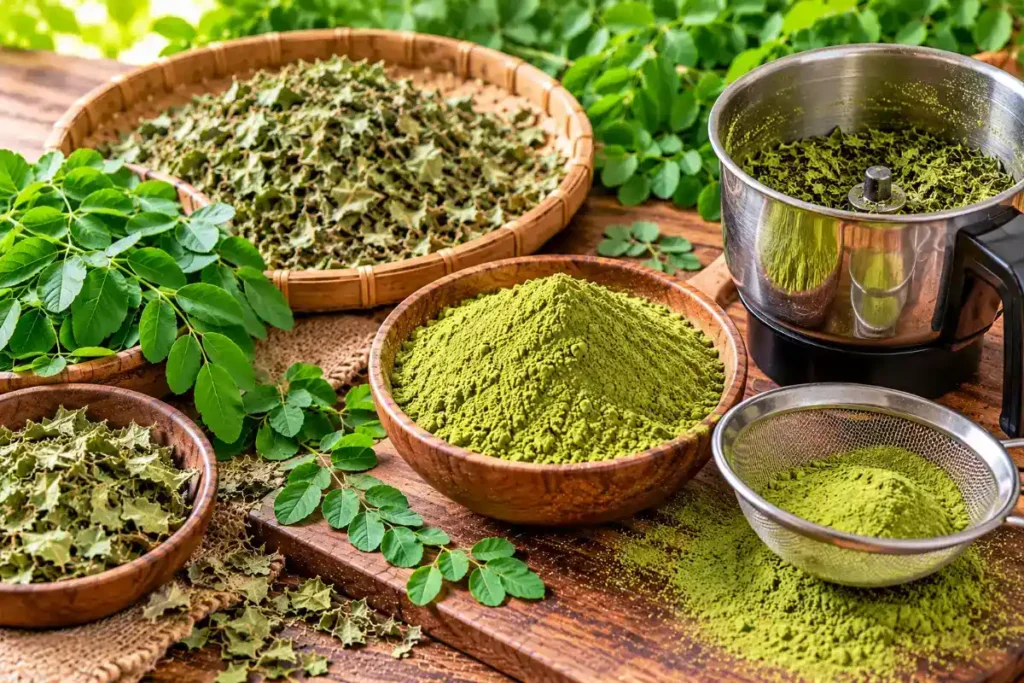
Making moringa powder at home involves several basic steps:
- Select fresh, healthy moringa leaves.
- Remove damaged leaves and thick unwanted stems.
- Clean the leaves properly.
- Allow excess surface water to drain.
- Dry the leaves using a suitable method.
- Make sure the leaves are thoroughly dry.
- Grind the dried leaves into a fine powder.
- Sieve the powder if a finer texture is preferred.
- Store it in a clean, dry, airtight container.
The most important part is not simply grinding the leaves. Complete and appropriate drying is essential before grinding and storing the powder.
We will cover the complete process separately in:
How to Make Moringa Leaf Powder at Home: Step-by-Step Guide
How to Store It Properly
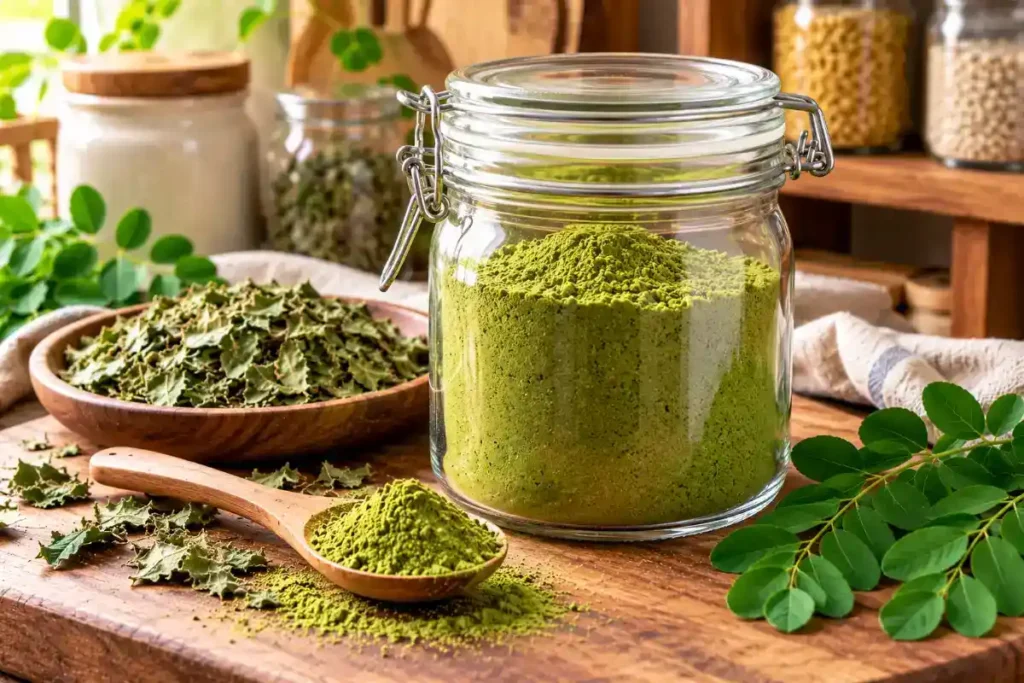
Once prepared, moringa powder should be protected from moisture, heat, light and unnecessary exposure to air.
A practical storage setup includes:
- A clean, completely dry airtight container
- A cool and dry storage location
- A tightly closed lid
- A dry spoon for every use
- Protection from steam and direct sunlight
Do not put a wet spoon into the container.
Moisture is particularly important because dried foods and powders can absorb moisture from their surroundings. General food-preservation guidance recommends keeping dried foods in clean, dry, moisture-resistant containers and storing them in cool, dry and dark conditions.
For detailed storage instructions, we will have a separate guide:
How to Store Moringa Powder: Keep It Dry & Fresh
How Much Powder Should You Use?
There is no universally established daily amount of moringa powder that can be recommended for everyone.
The appropriate amount can depend on the product, preparation, diet, health status and whether the powder is being used simply as a food ingredient or as a concentrated supplement.
This is one reason it is better not to present a single number as a medically proven daily dose.
If you are new to moringa, using a small amount as a food ingredient is a more sensible approach than immediately consuming large quantities.
People taking medicines or using concentrated herbal supplements should discuss regular use with a healthcare professional.
Side Effects and Safety
Moringa is commonly consumed as food, but concentrated products and supplements deserve more caution.
Memorial Sloan Kettering notes that moringa leaves and seeds are edible and that moringa powder can be mixed with liquids, while also advising people to discuss supplement use with a healthcare professional because herbal supplements can interact with medications. [Moringa safety and interaction information]
Memorial Sloan Kettering — Moringa oleifera Safety Information
Memorial Sloan Kettering notes that moringa leaves and seeds are edible and that moringa powder can be mixed with liquids, but also advises discussing supplement use with a healthcare professional because herbal products can interact with medications.
Possible concerns include:
- Digestive discomfort in some people
- Allergic reactions
- Potential interactions with medicines
- Uncertainty around concentrated supplement doses
- Additional safety concerns during pregnancy and breastfeeding
If you take medication for blood sugar, blood pressure or another chronic condition, do not assume that a natural product is automatically free of interactions.
Pregnant or breastfeeding individuals should consult a healthcare professional before using moringa products, particularly concentrated supplements.
Who Should Be Careful With Moringa Powder?
Extra caution is appropriate if you:
- Take prescription medicines regularly
- Are pregnant or breastfeeding
- Have a chronic medical condition
- Have known food or plant allergies
- Are considering high-dose supplements rather than normal food use
Another important point is product quality. Powder that has been poorly dried, handled or stored can have quality and microbiological concerns.
For homemade powder, clean handling and proper moisture control are therefore essential.
Moringa Leaf Powder vs Fresh Moringa Leaves
Both forms have their place in the kitchen.
Fresh moringa leaves are useful when you want to cook a traditional leafy vegetable preparation.
Moringa powder is more convenient when you want a shelf-stable ingredient that can be added in small quantities to different foods and drinks.
If you regularly have access to fresh moringa leaves, making your own powder can also be a useful way to preserve part of the harvest.
Can You Drink It Every Day?
Daily use is a common question, but there is no single amount that can be considered appropriate for every person.
For normal food use, moringa powder can be incorporated into meals or drinks in modest amounts. However, taking large quantities or using concentrated supplements regularly is a different situation.
If you have a medical condition or take medication, it is better to discuss regular use with a healthcare professional.
Is Moringa Powder Better Than Fresh Moringa Leaves?
Not necessarily.
Fresh leaves are a useful whole food, while powder is a convenient dried form.
The better choice depends on how you plan to use it.
If you cook moringa regularly, fresh leaves may be more practical. If you want something convenient to add to smoothies, dal or other dishes, powder can be easier.
Common Mistakes When Using Moringa Powder
Avoid these common mistakes:
Using Too Much at Once
Moringa has a strong flavour. Starting with a large quantity can make food or drinks unpleasant.
Storing It in a Humid Place
Humidity can cause powder to absorb moisture and form lumps.
Using a Wet Spoon
Even a small amount of water entering the container repeatedly can affect the powder over time.
Treating It Like Medicine
Moringa is a food ingredient with interesting nutritional and research properties. It should not replace prescribed medical treatment.
Making Unproven Health Claims
Claims about curing diabetes, losing weight rapidly or treating other diseases should not be treated as established facts.
Simple Ways to Add Moringa to Your Diet
If you want to start using moringa powder, you do not need a complicated routine.
Try it in:
- Water
- Smoothies
- Dal
- Soup
- Curd
- Chaas
- Chutney
- Roti or paratha dough
- Savory breakfast dishes
Start small, see how the flavour works with your food and keep the powder properly stored.
For more practical ideas, see our upcoming guide:
How to Use Moringa Powder: Easy Ways to Add It to Food & Drinks
Frequently Asked Questions
What is moringa powder made from?
Moringa powder is commonly made by drying and grinding moringa leaves from the Moringa oleifera plant.
What is moringa powder used for?
It is commonly used as a food ingredient in drinks, smoothies, dal, soups, chutneys, curd and other recipes.
Can moringa powder be mixed with water?
Yes. Moringa powder can be mixed with water, although the taste may be strong. Starting with a small amount can make the drink easier to tolerate.
Can moringa powder be added to smoothies?
Yes. A small amount can be blended into fruit, vegetable or yogurt-based smoothies.
Is moringa powder the same as moringa leaf powder?
In most food contexts, the terms are used for the same type of product when the powder is made from dried moringa leaves.
How should moringa powder be stored?
Keep it in a clean, dry, airtight container in a cool, dry place away from moisture, heat and direct sunlight.
Is moringa powder safe for everyone?
Not necessarily. Normal food use and concentrated supplements are different. People who take medicines or are pregnant or breastfeeding should seek professional advice before regular or concentrated use.
Final Thoughts
Moringa powder is a convenient way to use dried moringa leaves in everyday food and drinks. It can be added to smoothies, dal, soups, curd, chutneys and other preparations without requiring fresh leaves every time.
Research has identified a broad range of nutrients and bioactive compounds in moringa leaves, but evidence for specific medical benefits is still developing.
The simplest approach is to treat moringa powder as a useful food ingredient, use it in reasonable amounts, store it properly and avoid turning preliminary research into exaggerated health claims.